
Reframing Excellence, Execution, and Iteration in Modern Leadership

Executive Summary
For a generation of leaders, Jim Collins’ assertion that “good is the enemy of great” has functioned as a rallying cry against complacency — a reminder that settling for adequacy quietly erodes organizational potential.¹ Yet in today’s operating environment — defined by accelerated change, compressed decision cycles, and constant innovation pressure — a different risk has emerged. Increasingly, organizations are not failing because they accept good performance. They are stalling because they hesitate to act until conditions feel perfect.
The modern leadership paradox is this: the pursuit of greatness, when mistimed, can suppress experimentation, slow learning, and discourage forward motion. Excellence becomes an abstract threshold teams feel obligated to meet before beginning — and progress waits. This paper argues that greatness is not always achieved by rejecting good work, but often by leveraging it. When properly sequenced, good execution becomes the engine of iteration, learning, and eventual excellence. In this context, the enemy is not good — it is the premature demand for great.
Foreword
Some of the most important leadership decisions I’ve made did not come with complete information, perfect timing, or the comfort of certainty. They came at moments when waiting felt safer — when refining the plan one more time promised the illusion of control — but where progress demanded action instead. Again and again, I’ve faced the same quiet question: Do we wait until this is great, or do we begin with what is good and trust that excellence will emerge through the work?
Experience has taught me that leadership lives inside that tension.
Across nonprofit management, staffing environments, and startup ventures, I have rarely had the luxury of acting with full clarity. What I have had — and what leaders almost always have — is a responsibility to move forward anyway. Not recklessly, and not without standards, but with the understanding that progress creates the information that planning alone cannot. Once action begins, feedback replaces assumption. Teams discover what works. Blind spots surface. Direction sharpens. Improvement becomes tangible. Excellence stops being theoretical and starts becoming earned.
This philosophy is grounded in a belief I hold deeply: progress over perfection does not mean lowering standards — it means sequencing them wisely. I pursue high standards relentlessly. Continuous improvement is not optional; it is the discipline that transforms early effort into meaningful outcomes. But I have learned that perfection pursued too early can quietly stall momentum. Excellence is rarely present at inception. It is forged through iteration, adaptation, and the willingness to refine what already exists.
I think of this approach as rigid flexibility. We establish guardrails — values, expectations, and intended outcomes — that anchor our work. Within those boundaries, we remain open to change. Ideas are welcomed regardless of where they originate. Some of the most transformative insights I’ve encountered have come from people closest to the work — individuals empowered to challenge assumptions and contribute freely. When collaboration operates without ego or hierarchy, the result is often greater than anything a single leader could design. The work becomes collective, resilient, and stronger for it.
These lessons did not begin in boardrooms or startups. They trace back to my earliest leadership experience — as a 13-year-old patrol leader in the Boy Scouts of America with Troop 2 in Athens, Georgia. Our scoutmaster demanded excellence in everything we did: how tents were rolled, how meals were prepared, how we conducted ourselves, and even how we wore the uniform. When I was given the opportunity to lead a newly formed patrol made up of the youngest scouts in the troop, I quickly learned that excellence was not something you inherited — it was something you organized around.

1997 - Broad River, GA - Shark Patrol, Troop 2 BSA - Lane seated on far right
We were a group of 12- and 13-year-olds, peers learning to lead one another in real time. Within the guardrails of the troop’s expectations, we created our own identity and standards. We named ourselves the Shark Patrol. We designed and built our own flag — imperfect in craftsmanship, but powerful in meaning. It symbolized ownership, pride, and a shared commitment to doing things well. That flag wasn’t about decoration; it was a statement that we intended to operate with purpose and discipline, even as newcomers.
Action followed identity. We organized ourselves to raise funds — mowing lawns, running car washes — so we could purchase materials to build our own foot lockers. Those lockers carried our gear, but more importantly, they carried the pride of work we had planned, funded, and completed together. Leadership in that environment meant motivating peers, coordinating effort, and holding one another accountable to standards we collectively embraced. We were imperfect, learning constantly, and adjusting as we went. Yet the pride came not from flawlessness, but from ownership, iteration, and the shared pursuit of excellence.
I have refined those lessons across nonprofit leadership, staffing environments, and startup ventures, but their foundation remains unchanged. Those early experiences taught me that excellence is not the absence of imperfection — it is the discipline of improvement sustained over time, anchored by identity, collaboration, and the courage to act before everything feels finished.
This white paper reflects that lived perspective. It challenges the assumption that good work inherently obstructs greatness and instead argues for a more dynamic relationship between action and excellence. The pursuit of high standards remains essential. But progress — guided by discipline, strengthened by collaboration, and informed by feedback — is what allows those standards to take root.
If there is a central conviction behind these pages, it is this: leadership is not about choosing between good and great. It is about having the courage to begin, the humility to improve, and the discipline to keep moving until excellence becomes the natural result of the journey.

Collins’ Framework: The Discipline of Rejecting Complacency
Collins’ landmark research examined organizations that achieved sustained performance breakthroughs and found a common cultural thread: a disciplined refusal to accept mediocrity.¹ Leaders in these companies cultivated focus, accountability, and long-term commitment to improvement. The underlying behavioral insight was clear — satisfaction with “good enough” results reduces urgency, dampens ambition, and stabilizes systems around adequacy.
Organizational theory reinforces this dynamic. When performance meets expectations, adaptive tension — the productive discomfort that drives transformation — tends to dissipate.² In stable industries or mature institutions, complacency is a credible threat. Collins’ framework remains powerful in environments where inertia is the dominant barrier to advancement.
However, his model implicitly assumes that comfort is the primary obstacle to excellence. Modern execution environments complicate that assumption.
The Modern Constraint: Perfection as Operational Friction
Contemporary leadership research increasingly identifies over-optimization and perfectionism as sources of delay rather than excellence. Edmondson’s work on psychological safety shows that teams accelerate learning when experimentation is normalized and early imperfection is tolerated.³ Ries’ lean innovation framework similarly demonstrates that releasing minimally viable work reduces uncertainty and increases adaptive speed.⁴
In practice, cultures that elevate perfection as a prerequisite to action often experience:
Delayed execution due to excessive refinement
Risk aversion disguised as quality control
Reduced feedback loops
Decision fatigue driven by over analysis
Behavioral research confirms that perfection-oriented systems can unintentionally suppress initiative and amplify fear of failure.⁵ What appears to be rigor becomes friction. Teams wait for conditions that never fully materialize, trading momentum for the illusion of certainty.
Under these conditions, the pursuit of “great” transforms from aspiration into constraint. Progress stalls not because standards are high, but because action is deferred.
Good as a Strategic Platform for Emergent Excellence
Modern execution frameworks — from agile management to lean innovation — reframe early-stage output as a strategic asset.⁶ Rather than treating initial work as final, these systems treat it as a learning instrument. The operational logic is iterative:
Action produces informed results
Feedback sharpens direction
Refinement compounds performance
Here, “good” is not an endpoint — it is a deliberate starting condition. Execution generates information that planning alone cannot reveal. Each cycle reduces uncertainty and increases capability.
March’s exploration–exploitation model underscores this balance: organizations that sustain long-term performance alternate between experimentation and refinement.⁷ Greatness emerges not from waiting for perfect conditions, but from disciplined cycles of doing, learning, and improving.
In this framework, rejecting early action in pursuit of theoretical perfection delays the very process through which excellence becomes attainable.
Leadership Implications: Sequencing Excellence and Momentum
Modern leaders must navigate two competing risks:
Guarding Against Complacency
Sustain performance expectations
Encourage continuous improvement
Resist comfort-driven stagnation
Guarding Against Paralysis
Normalize iterative execution
Reward learning velocity
Reduce fear associated with early imperfection
Effective leadership lies in sequencing these disciplines. Standards remain high, but action is prioritized. Teams are encouraged to move decisively while maintaining accountability for refinement. Excellence becomes an emergent property — achieved through momentum, not delayed by it.
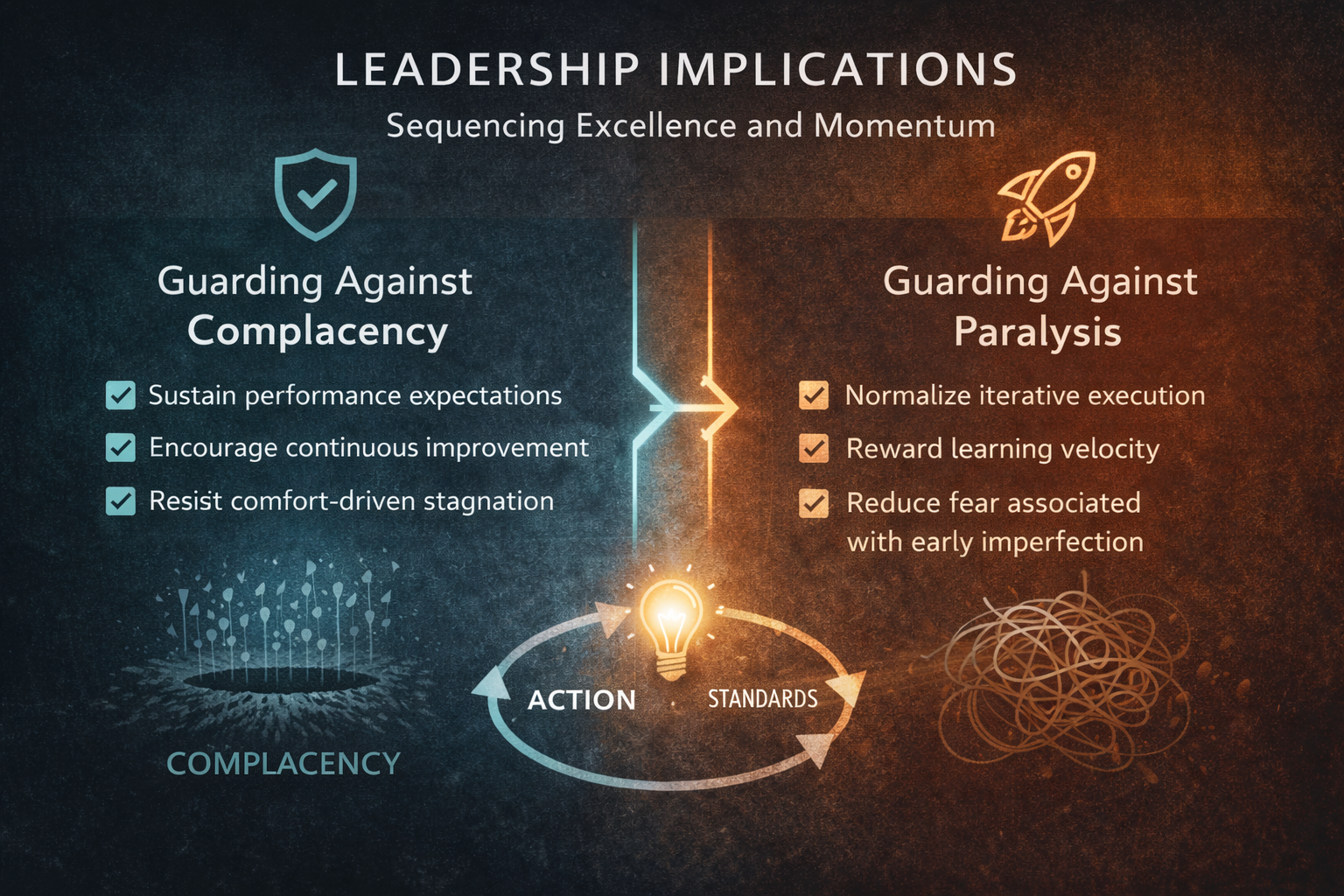
Organizations that master this balance cultivate resilience. They preserve ambition without sacrificing adaptability, allowing progress to compound rather than stall.
Conclusion
Collins’ warning against complacency remains a foundational leadership principle. Yet modern operating conditions reveal a complementary truth: the premature pursuit of perfection can be equally limiting. Organizations that defer execution in search of ideal conditions sacrifice the feedback and learning that drive sustained excellence.
Greatness rarely arrives fully formed. It is constructed through disciplined iteration, informed risk-taking, and continuous adjustment. In this light, good is not the enemy of great — it is often the mechanism through which greatness becomes possible.
The leadership imperative is not to choose between good and great, but to understand their sequence. When leaders reverse the enemy — recognizing when the pursuit of great blocks progress — they unlock a more adaptive path to enduring excellence.
References
Collins, J. (2001). Good to Great: Why Some Companies Make the Leap… and Others Don’t. HarperBusiness.
Cyert, R., & March, J. (1963). A Behavioral Theory of the Firm. Prentice Hall.
Edmondson, A. (2018). The Fearless Organization. Wiley.
Ries, E. (2011). The Lean Startup. Crown Business.
Stoeber, J., & Otto, K. (2006). Positive conceptions of perfectionism. Personality and Social Psychology Review.
Highsmith, J. (2009). Agile Project Management. Addison-Wesley.
March, J. (1991). Exploration and exploitation in organizational learning. Organization Science.
This white paper represents the author’s professional perspective and does not reflect the official position of any organization or regulatory agency.
Author: Peter S. Lane
Subject Matter Expertise: FAA Part 147 Aviation Maintenance Education, Workforce Development, Industry Partnerships, Educational Technology, Nonprofit Management, Board Governance, Staffing Industry, Sales & Marketing
Affiliations: Executive Advisor and Former Founding Executive, FAA Part 147 Certified Aviation Maintenance Training Organization, Member Aviation Technician Education Council, Member National Eagle Scout Association
Date: February 18, 2026
#ExecutiveLeadership
#OrganizationalExcellence
#ProgressOverPerfection
#WorkforceDevelopment
#AviationWorkforce
#InnovationInAviation
