
The Novelty AIR Training Model
Aviation. Innovation. Readiness.
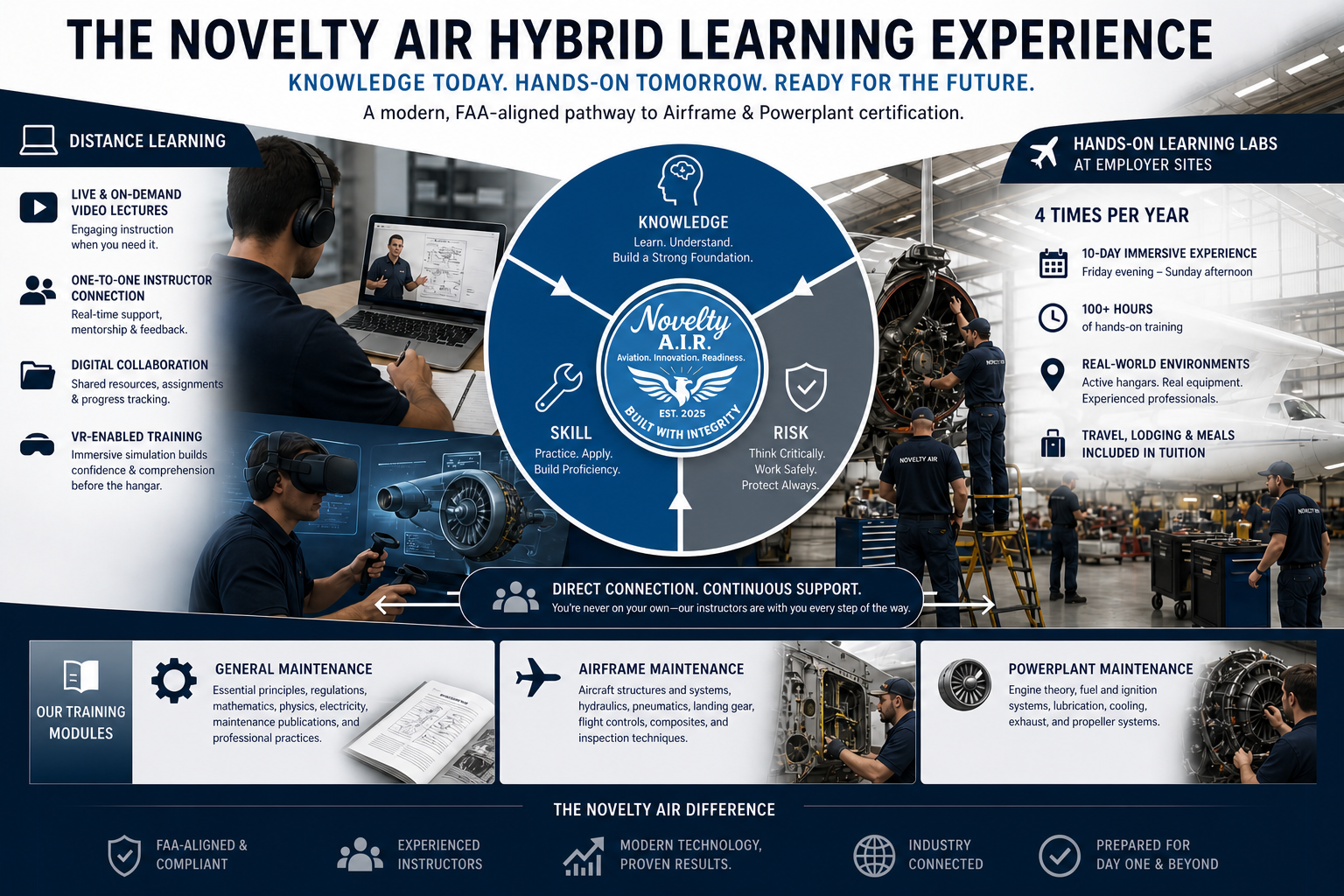
Novelty AIR delivers a modernized Aviation Maintenance Technician (AMT) training experience—built for today’s workforce and aligned with the future of aviation. Our hybrid model integrates distance learning, immersive simulation, and hands-on employer-based training to develop technicians who are not only certified—but truly ready.
This is not a departure from FAA standards—it is a disciplined evolution within them.
A Fully Integrated Learning Experience
Our program is designed around the three pillars defined by FAA Airman Certification Standards: knowledge, skill, and risk management.
Knowledge is delivered through a structured Learning Management System (LMS), combining live instruction, pre-recorded lectures, and curated digital content.
Skill is developed through immersive Virtual Reality (VR) simulations and reinforced through intensive, real-world application.
Risk awareness is embedded throughout—training students to think critically, act deliberately, and uphold the highest standards of safety.
Students are never learning alone. Every course includes direct, one-to-one engagement with FAA-certified instructors, supported by real-time collaboration tools and continuous mentorship.
Quarterly Immersive Training Labs
Where Learning Becomes Capability
Four times per year, students participate in 10-day, in-person immersion experiences at active employer partner sites across the country.
100+ hours of hands-on training per session
Friday evening through Sunday afternoon (10-day format)
Conducted in real aviation maintenance environments
Travel, lodging, and meals included in tuition
These are not classroom simulations—they are operational environments where students apply what they’ve learned, build muscle memory, and develop confidence under the supervision of experienced professionals.
This model ensures that when students step into a hangar, they are not starting from zero—they are accelerating forward.
Technology-Enabled, Instructor-Led
Our hybrid structure blends flexibility with accountability:
Live and on-demand instruction through our LMS
VR-enabled training to enhance comprehension and retention
Digital collaboration tools (including shared workspaces and guided resources)
Continuous instructor access for coaching, feedback, and mentorship
This approach allows students to learn efficiently without sacrificing depth, while maintaining a consistent connection to instructors and peers.
Our Training Modules
Novelty AIR’s program is structured around the three FAA-required instructional areas for Airframe & Powerplant certification:
General Maintenance
The foundation of the profession. Students develop core competencies in mathematics, physics, electricity, maintenance documentation, regulations, and human factors. This module establishes the discipline, safety mindset, and technical baseline required for all aviation maintenance work.
Airframe Maintenance
Focused on the aircraft itself. Students gain hands-on experience with structures, systems, and components—including hydraulics, pneumatics, landing gear, flight controls, sheet metal, and composites. Training emphasizes inspection, repair, and system integrity.
Powerplant Maintenance
Centered on engines and propulsion systems. Students study and apply principles related to fuel systems, ignition, lubrication, cooling, exhaust, and propellers—learning to inspect, troubleshoot, and maintain powerplants to exacting performance standards.
Instruction That Reflects the Industry
Our instructors are more than educators—they are working professionals and mentors.
FAA-certified Airframe & Powerplant (A&P) mechanics
Proven industry experience across aviation sectors
Certified through the ATEC Academy Instructor Training Program
Committed to safety, integrity, and student success
Instruction at Novelty AIR is structured, consistent, and student-centered, ensuring every graduate is supported not only academically—but professionally.
The Outcome
Graduates of Novelty AIR don’t just meet certification standards—they are prepared to contribute on day one.
They understand the systems.
They’ve trained in real environments.
They’ve built relationships with industry professionals.
And most importantly—they are ready.