
Aligning Workforce, Education, Industry, and Economic Growth for the Future of Flight
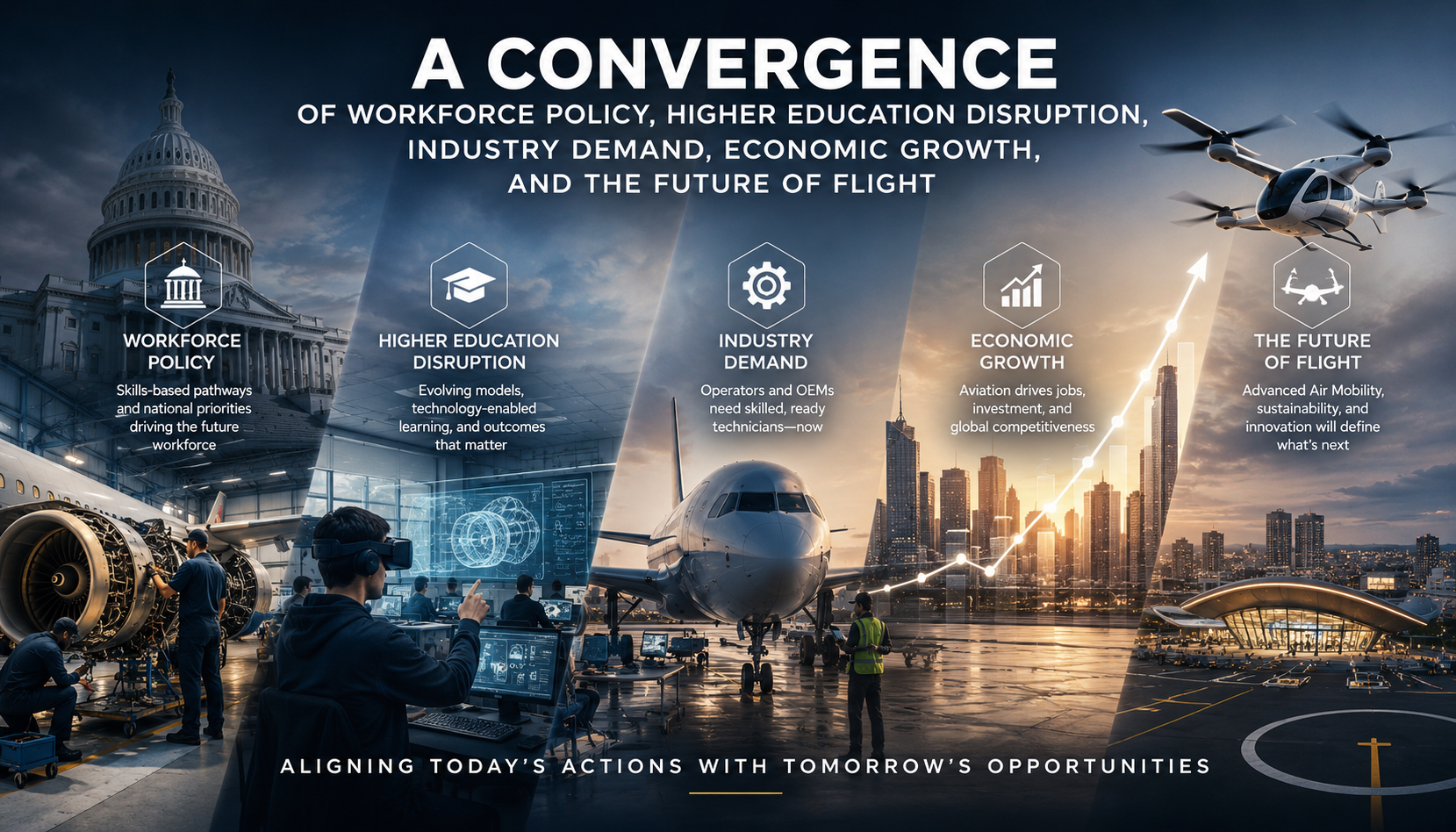
A Convergence of Workforce Policy, Higher Education Disruption, Industry Demand, Economic Growth, and the Future of Flight
The Moment We’re In
There are moments in industries where change is not gradual—it is structural, and aviation maintenance has entered one of those moments. Aircraft systems are becoming more integrated, more software-driven, and more dependent on precision and uptime than at any point in history. At the same time, expectations from operators, regulators, and passengers have risen in parallel, creating an environment where reliability is not just a goal, but a requirement. Yet despite these advancements, the systems used to train the people responsible for maintaining this technology have remained largely unchanged, creating a widening gap between capability and preparation.
What makes this moment more significant is that the pressure is not coming from aviation alone. Workforce policy across the United States is increasingly prioritizing skills-based pathways over traditional degree structures, while higher education institutions are being forced to defend their value in terms of outcomes rather than credentials. Students and families are asking more direct questions about return on investment, and employers are demanding clearer alignment between education and job readiness. When these forces converge—as they are now—they don’t just suggest change; they demand it, as outlined in Deloitte’s 2026 Higher Education Trends report and further interpreted by Paxton Riter, Co-Founder and CEO at iDesign.
What the Industry Told Me
In March and April of 2026, I attended VERTICON and MRO Americas with a simple objective: test whether the workforce problem I believed existed actually held up in the market. I didn’t approach these conversations with a pitch deck or a predefined solution; instead, I asked a straightforward question to operators, maintenance leaders, and executives across the industry—“Are you having difficulty finding technicians?” The answer came quickly and consistently, but what stood out was not the answer itself. It was how quickly the conversation moved beyond recruiting and into something deeper.
As discussions progressed, the focus shifted from access to talent toward the quality and preparedness of that talent. When I asked whether new technicians were ready when they arrived, the response changed in tone, often becoming more measured and more candid. Across conversations with Directors of Maintenance, Vice Presidents, and operational leaders, a consistent theme emerged: the issue was not simply a shortage of people, but a shortage of readiness. This distinction is critical, because it reframes the problem from one of supply to one of system design.
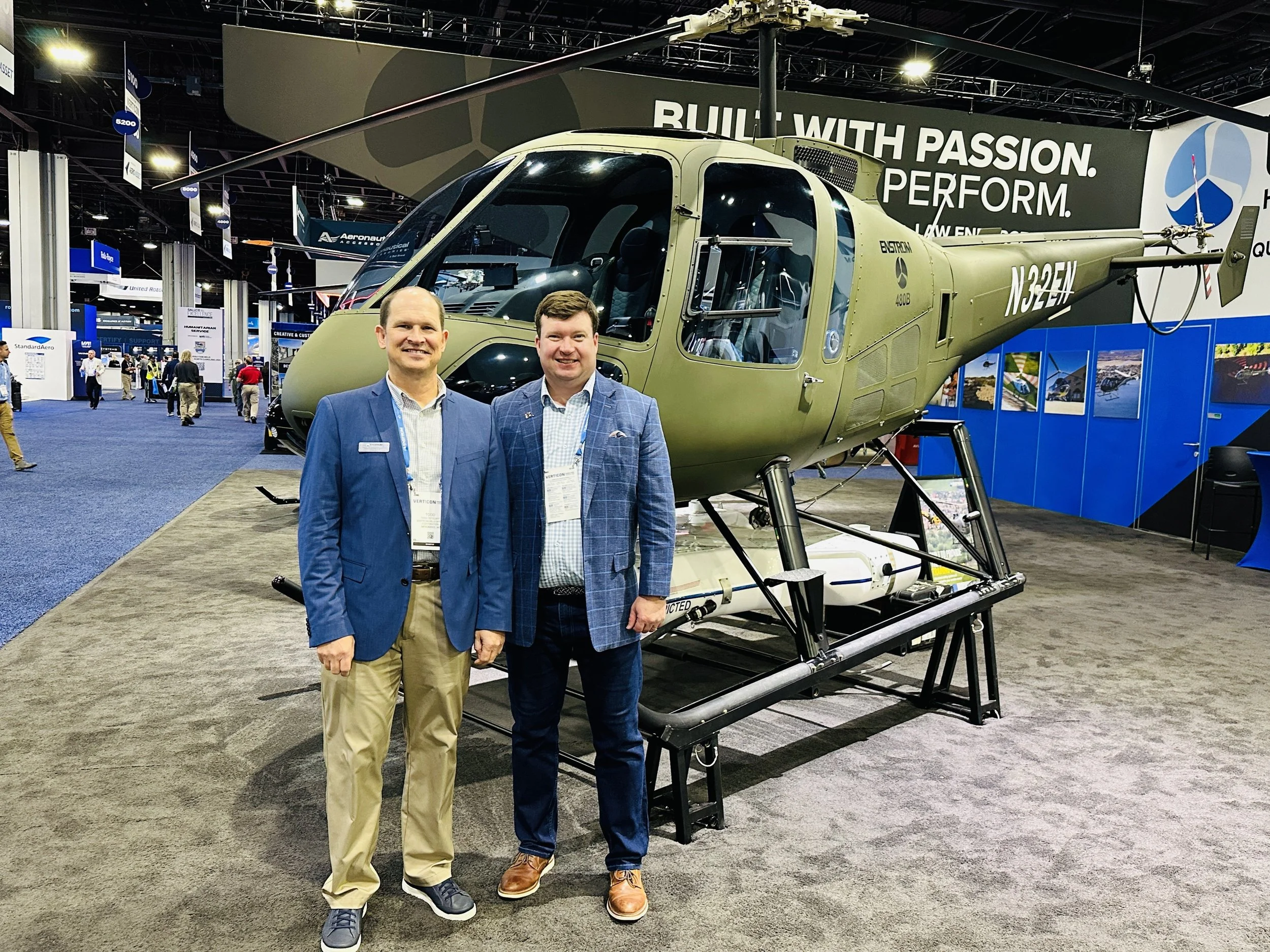
VERTICON 2026, Atlanta, GA:
Todd Tetzlaff, Enstrom Helicopter, EVP Regulatory Affairs & Global Relations
with Peter Lane, Novelty AIR, Founder & CEO
The Gap No One Is Solving
What employers described was not a lack of effort or intelligence among new technicians, but a gap between what they had learned and what the job required. Many graduates understood individual components—how a system was supposed to function in isolation—but struggled when faced with real-world scenarios where multiple systems interacted. When something failed outside of a controlled or familiar context, troubleshooting became difficult, and in aviation maintenance, troubleshooting is not a secondary skill; it is the core function of the profession.
Beyond technical capability, employers also pointed to professional readiness factors that are harder to teach in traditional environments. Communication, accountability, and the ability to function within a team-based operational setting were cited just as frequently as technical deficiencies. These are not abstract qualities; they are essential components of safe and effective maintenance operations. When viewed together, these insights point to a single underlying issue: training environments are still too far removed from the environments in which the work actually occurs.
Where the Industry Is Already Moving
Encouragingly, the industry has already begun to respond to this gap. In “Intensified Labor Competition Drives New MRO Workforce Strategies,” written by Lindsay Bjerregaard, Managing Editor of MRO at Aviation Week Network, it is highlighted how companies are stepping directly into the training process. Safran, for example, has partnered with the Aviation Institute of Maintenance to embed students within operational environments, while Frontier Airlines has collaborated with Aims Community College to align training with real-world exposure and long-term hiring pathways. These initiatives demonstrate a clear recognition within the industry that training must move closer to the work itself.
However, while these examples are meaningful, they also reveal a limitation. These programs are typically localized, built around specific partnerships between individual employers and institutions, and constrained by geography. They represent important progress, but they do not yet constitute a scalable solution. What they show is direction, not infrastructure—and that distinction defines the opportunity ahead.
From Programs to Platforms
There is a fundamental difference between proving that something works and building the system that allows it to scale. The industry today is rich with pilot programs—initiatives that demonstrate the value of embedding training within operational environments—but these programs remain fragmented and limited in reach. They solve the problem in one location, for one employer, at one moment in time, without creating a broader framework that can be replicated across the industry.
A platform, by contrast, is designed for scale from the outset. It connects multiple employers, distributes training across geographies, and standardizes outcomes while allowing for local flexibility. This is the transition aviation maintenance training must make: from isolated partnerships to a coordinated, national infrastructure that aligns education directly with workforce demand. Without that shift, progress will remain incremental when the need is systemic.
Why This Moment Exists Now
To understand why this shift is happening now—and not ten years ago—you have to step outside of aviation. This is not simply an aviation story; it is the convergence of broader forces reshaping higher education and workforce development at a national and global level. According to Deloitte’s 2026 Higher Education Trends Report, institutions are entering a period defined by two unmistakable pressures: a shrinking pipeline of incoming students and intensified scrutiny around the value of education. Prospective students and their families are asking a far more direct question than in prior generations—“Will this lead to a good job?”—and institutions that cannot answer that with clarity and confidence are steadily losing ground.
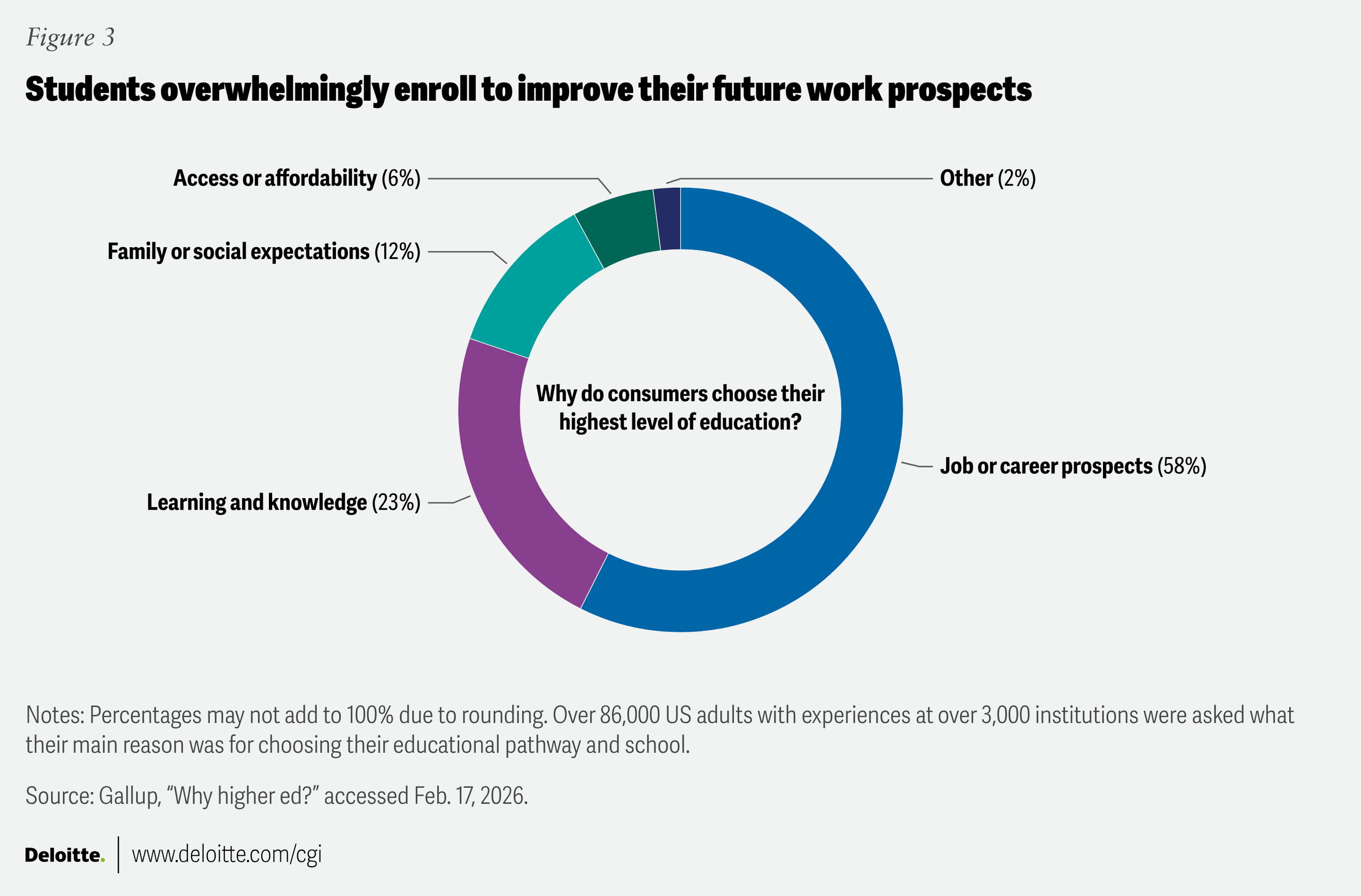
Nearly 60% of students enroll in post-secondary or higher education to get a good job as the primary driver.
At the same time, Deloitte highlights a defining inflection point: the institutions most likely to endure are those that embrace technology, adopt hybrid and flexible delivery models, and build direct, measurable connections to workforce outcomes. This is the macro signal—one that extends well beyond aviation and into the fundamental redesign of how education is delivered, measured, and valued.
This shift is not accidental. It is the natural result of mounting economic, demographic, and technological pressures. As emphasized by workforce strategist Paxton Riter, institutions that successfully adapt will be those that align tightly with employer needs while building models that are both flexible and scalable. His analysis reinforces a simple but critical truth: legacy structures are no longer sufficient for the demands of a modern workforce.
That perspective is further validated at the federal level. Henry Mack III, Assistant Secretary of Labor for Policy, has stated that “higher education needs to reimagine itself around the needs of employers and their workplaces,” underscoring a national policy shift toward employer-integrated training models. Together, these viewpoints—from global consulting, industry practitioners, and federal leadership—point to a single conclusion: education is being pulled closer to the point of employment than ever before.
What That Means in Practice
In practical terms, this transformation is redefining the very foundation of education. As Riter articulates, “the institutions that will succeed are those that move fastest toward workforce-aligned, flexible, and scalable models.” The implication is clear: the traditional markers of education—seat time, centralized campuses, and rigid delivery structures—are no longer the primary indicators of value.
Instead, the future will be defined by outcomes, adaptability, and direct pathways to employment. Programs that can demonstrate clear career alignment, integrate seamlessly with industry environments, and provide flexible access to learning will set the new standard. This is not a marginal evolution; it is a structural shift—one that creates both urgency and opportunity for those positioned to lead within it.
And That’s Where Aviation Stands Apart
Aviation maintenance occupies a unique position within this broader shift because the connection between training and employment is unusually direct. Earning an FAA Airframe and Powerplant certification leads to immediate demand in the job market, a reality supported by ATEC Workforce Data and reinforced by Oliver Wyman’s Aviation Maintenance Pipeline Report.
This is not speculative demand; it is operational necessity. Aircraft must be maintained, and maintenance requires certified professionals. Yet even within this clear pathway, the readiness gap persists, indicating that the issue is not the availability of opportunity but the effectiveness of preparation.
Building the Pipeline—And Recognizing What’s Working
Programs like Choose Aerospace, supported by AAR Corporation and developed in partnership with the Aviation Technician Education Council represent an important advancement in addressing the pipeline challenge. By introducing students to aviation maintenance concepts as early as high school, these programs create awareness, build foundational skills, and provide a tangible entry point into the profession.
These efforts deserve recognition because they strengthen the front end of the pipeline. However, pipeline development alone does not solve the readiness gap. The next step is not just earlier engagement, but deeper integration.
The Next Frontier: Advanced Air Mobility
At VERTICON, Advanced Air Mobility (AAM) was not presented as a distant concept but as an active and evolving segment of the industry. Companies such as Joby Aviation, Archer Aviation, and Eve Air Mobility are redefining aircraft design through electric propulsion, integrated software systems, and advanced materials.
If the industry waits until these platforms are fully scaled to begin training technicians, it will replicate the same readiness gap at a higher level of complexity.
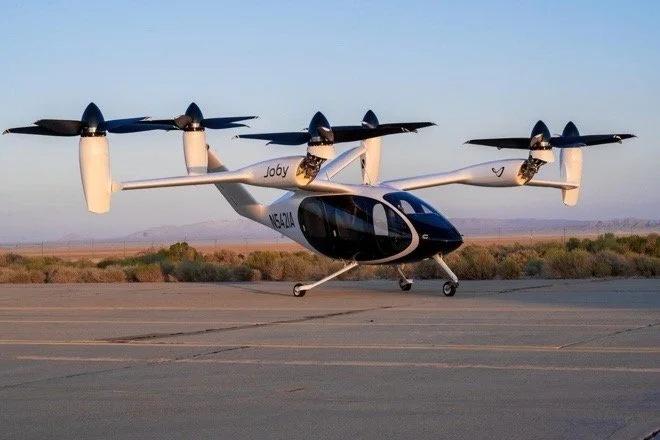
These new aircraft, like Joby Aviation (pictured), are redefining air travel.
Workforce Development as an Economic Engine
Workforce development in aviation maintenance is not only an industry imperative but also an economic one. A well-trained workforce increases operational efficiency, reduces downtime, and enables greater utilization of existing assets, all of which contribute directly to economic output. In a broader context, increasing the number of skilled technicians entering high-demand, high-wage careers supports income growth, tax revenue, and overall economic productivity.
At a time when national economic discussions increasingly focus on debt, productivity, and competitiveness, investment in workforce development offers a practical and non-partisan pathway forward. Aviation maintenance, with its clear demand signals and direct economic impact, represents a compelling area for such investment. By mobilizing existing infrastructure and aligning it with workforce needs, the industry can contribute not only to its own sustainability but to the broader economy as well.
The Convergence—and the Opportunity
When viewed collectively, the forces shaping this moment—workforce policy, higher education disruption, industry demand, economic priorities, and technological advancement—are converging, and a clear picture emerges.
Workforce policy is pushing toward skills-based, employer-aligned training. Higher education is being forced to prove value and adopt new delivery models. The aviation industry is actively searching for ways to close the readiness gap. Individually, each of these forces creates pressure. Together, they create alignment.
And at that intersection sits a new model for workforce development.
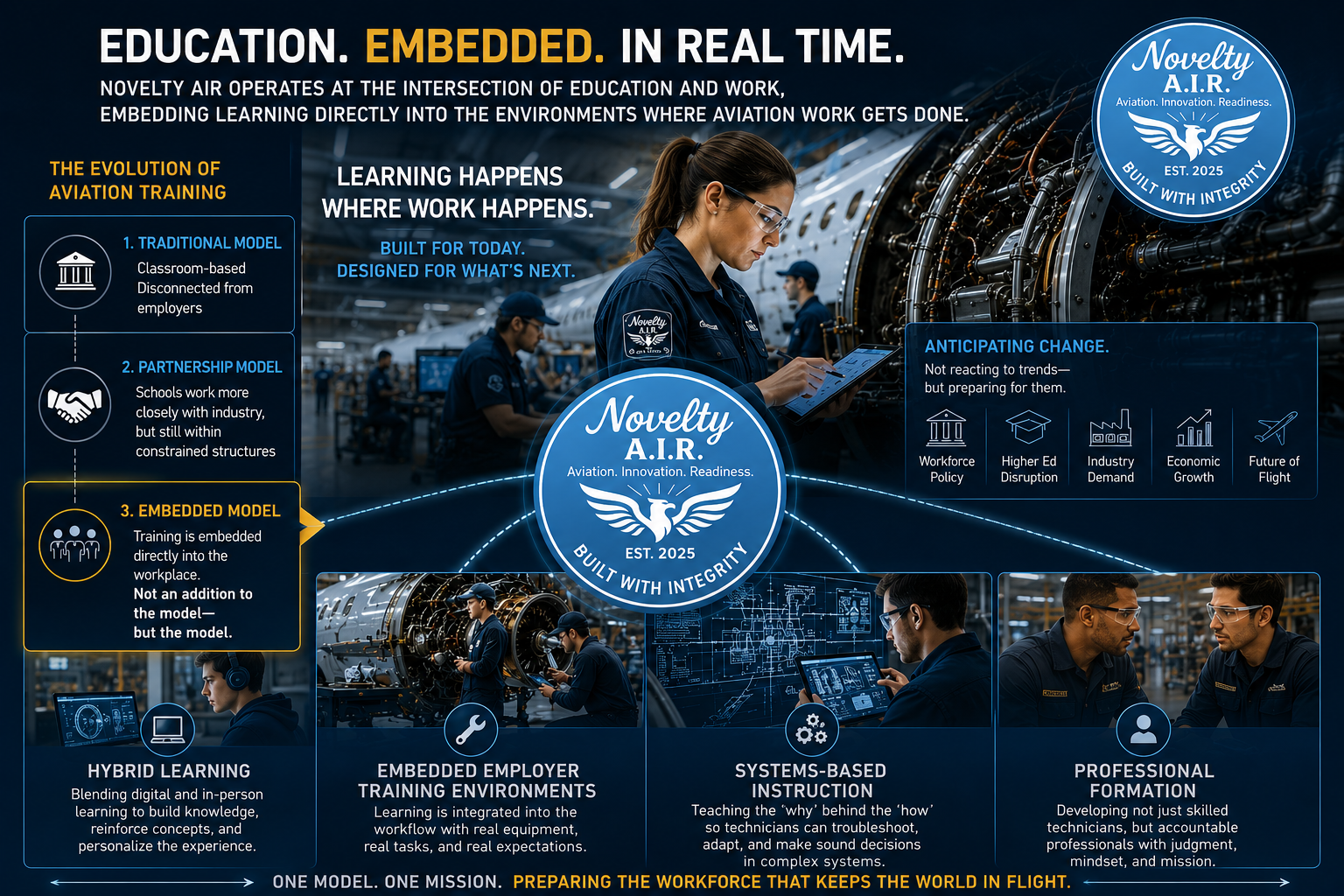
The Model
Novelty AIR is designed to operate at that intersection, embedding education directly into the workplace. Not as a reaction to these trends—but in anticipation of them. A model where the classroom is no longer separate from the workplace. But integrated into it.
A model that combines:
Hybrid learning
Embedded employer training environments
Systems-based instruction
Professional formation
If you step back, the progression becomes clear. Educators started with a traditional model—classroom-based, largely disconnected from employers. Then moved into a partnership model—schools working more closely with industry, but still within constrained structures. And now, we are entering a new phase. One where training is embedded directly into the environments where the work is performed.
Not as an addition to the model—but as the model itself.
CLOSING THOUGHT
What I observed at VERTICON and MRO Americas was not a fragmented set of challenges, but a system under pressure that is beginning to adapt.
Novelty AIR builds on early industry adoption of employer-integrated training and scales it into a national, employer-embedded platform designed to produce workforce-ready aviation maintenance professionals—aligned with current demand and prepared for the future of flight.

Author: Peter S. Lane
Subject Matter Expertise: FAA Part 147 Aviation Maintenance Education, Workforce Development, Industry Partnerships, Educational Technology
Affiliations: Founding Executive for multiple FAA Part-147 Aviation Maintenance Technician Schools (AMTS); member Aviation Technician Education Council (ATEC); attendee VERTICON, MRO AMERICAS, and ATEC Annual Conference.
This white paper represents the author’s professional perspective and does not reflect the official position of any other person, organization or regulatory agency.
#AviationMaintenance #WorkforceDevelopment #Education #EdTech #TradeSchools #MROAM #Verticon #AAM
