
The Role of Aviation Technicians in WWII
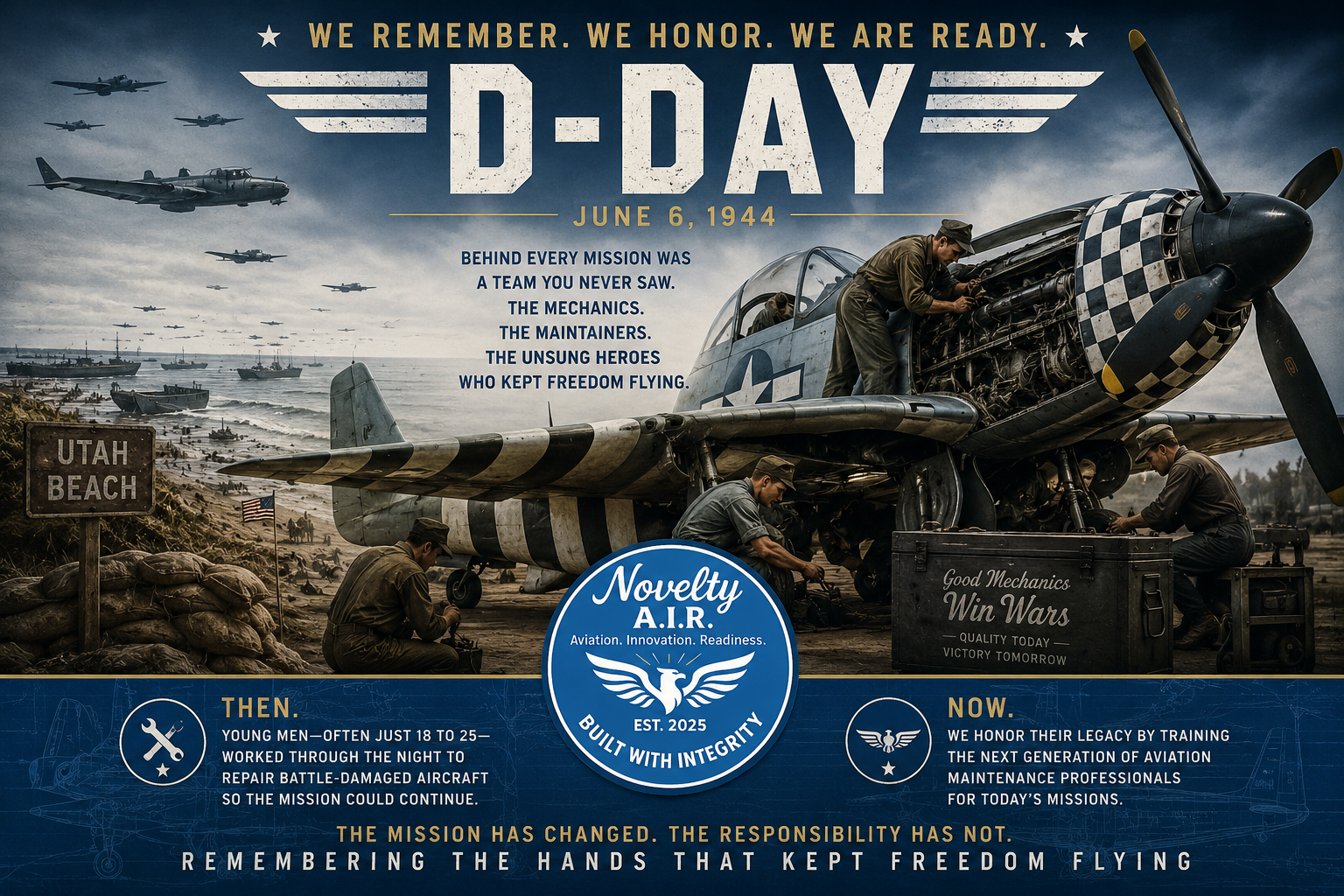
Novelty AIR’s Tribute to D-Day.
Each year as June 6 arrives, we pause to remember one of the most consequential days in human history.
On June 6, 1944, Allied forces crossed the English Channel and landed on the beaches of Normandy. The operation that history now remembers as D-Day marked the beginning of the end for Nazi Germany's occupation of Western Europe. Thousands of soldiers, sailors, airmen, and support personnel participated in an undertaking of extraordinary scale and complexity.
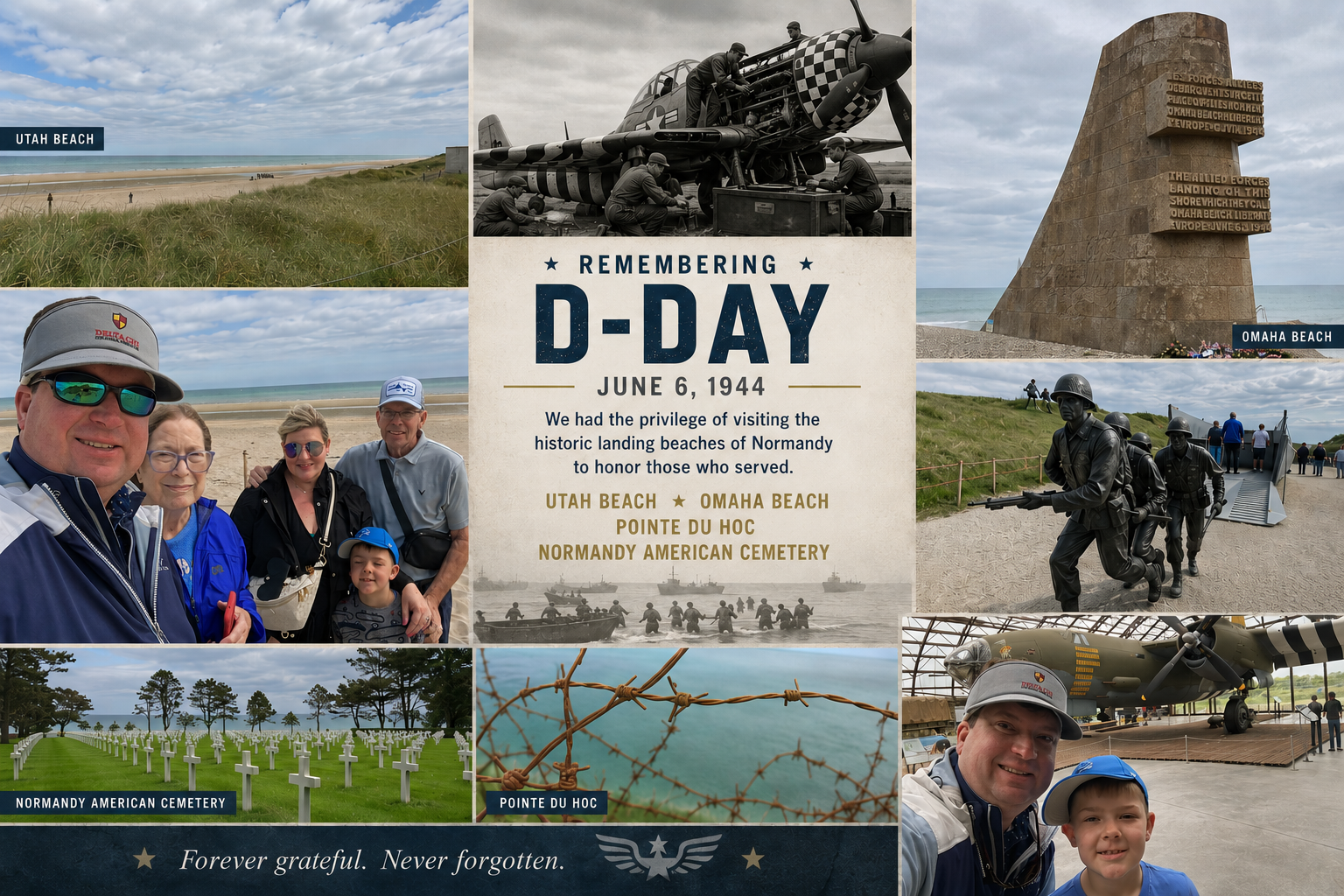
In 2024, my family and I had the opportunity to visit Utah and Omaha Beaches, Pointe du Hoc, and the Normandy American Cemetery. Standing on those beaches 80 years after the invasion was a powerful experience. The cliffs, the sand, and the rows of white marble crosses serve as reminders that history was not inevitable. Freedom was secured because ordinary men and women accepted extraordinary responsibilities.
Most Americans know the stories of the soldiers who fought their way ashore that morning. Many know the stories of the paratroopers who descended into darkness the night before. Fewer know the story of the aviation maintainers who helped make the invasion possible.
Yet their contribution was immense.
Before the first landing craft touched the beaches of Normandy, Allied aircraft had already spent months preparing the battlefield. Fighters, bombers, transports, reconnaissance aircraft, and gliders all played critical roles in the success of Operation Overlord. On D-Day alone, Allied air forces flew thousands of missions, with over 11,000 aircraft, in support of the invasion.
Those aircraft did not simply appear over France.
They were inspected, repaired, serviced, fueled, armed, and prepared for flight by an army of maintainers working behind the scenes.
By the end of World War II, nearly one-third of all enlisted personnel in the U.S. Army Air Forces were mechanics. Many were only 18 - 25 years old. While pilots often received public recognition, these young technicians worked long hours on windswept airfields throughout England, frequently under pressure to return damaged aircraft to service as quickly and safely as possible.
The aircraft returning from missions over occupied Europe rarely came home untouched. Many arrived with battle damage from anti-aircraft fire, enemy fighters, weather, or the cumulative stresses of combat operations. Wings were punctured. Control surfaces were damaged. Hydraulic systems leaked. Engines required replacement. Aircraft that had left England mission-ready often returned battered and broken.
The maintainers met that challenge with remarkable ingenuity and determination.
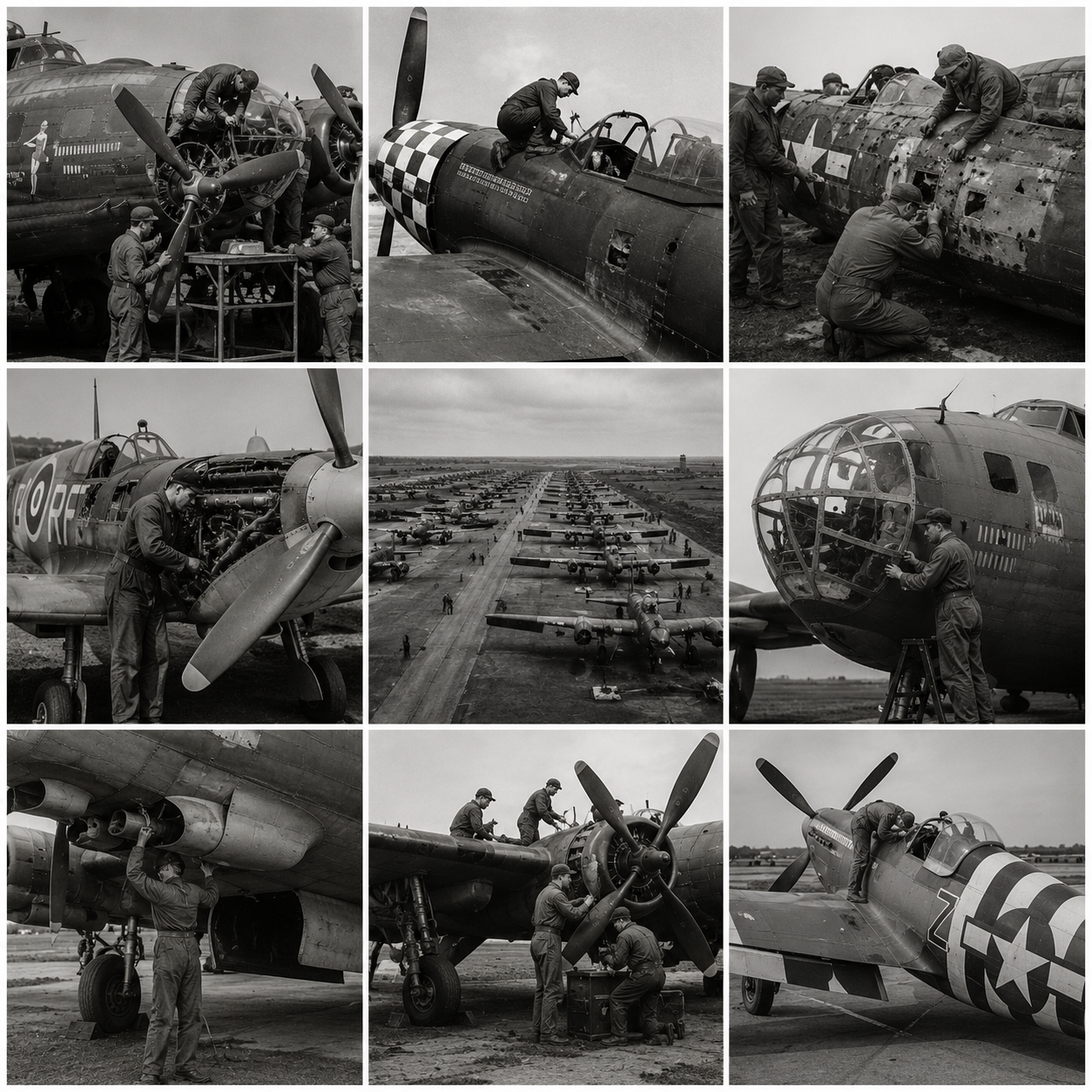
WWII Aviation Maintenance Technicians
Working through the night, they repaired battle damage, fabricated replacement parts, cannibalized components from aircraft beyond repair, and developed procedures that would eventually influence modern maintenance practices for decades to come. The pilots who climbed back into those aircraft the following morning often did so because they trusted the mechanics who had signed them off for flight. That trust became one of the defining characteristics of military aviation.
A pilot might fly the mission, but a crew chief, mechanic, electrician, sheet-metal specialist, or engine technician helped determine whether that aircraft would be ready to fly in the first place.
The significance of that workforce extends far beyond World War II.
The young men and women who maintained aircraft during the war became the foundation of the modern aviation industry. They returned home and helped build airlines, manufacturing companies, maintenance organizations, technical schools, and military aviation programs that would dominate the second half of the twentieth century. Their experience and craftsmanship helped establish the safety culture, technical standards, and professional expectations that continue to define aviation maintenance today.
In many ways, the modern aviation industry was built not only by pilots and engineers, but by maintainers.
Today, however, the industry faces a different challenge.
Aircraft are more sophisticated than ever before. Air travel continues to grow. Military readiness remains essential. Yet the pipeline of new aviation maintenance technicians has struggled to keep pace with industry demand. Across the country, employers are searching for qualified mechanics while many traditional educational models struggle to produce enough graduates to meet workforce needs.
This challenge is not entirely unlike the one faced by the United States during World War II.
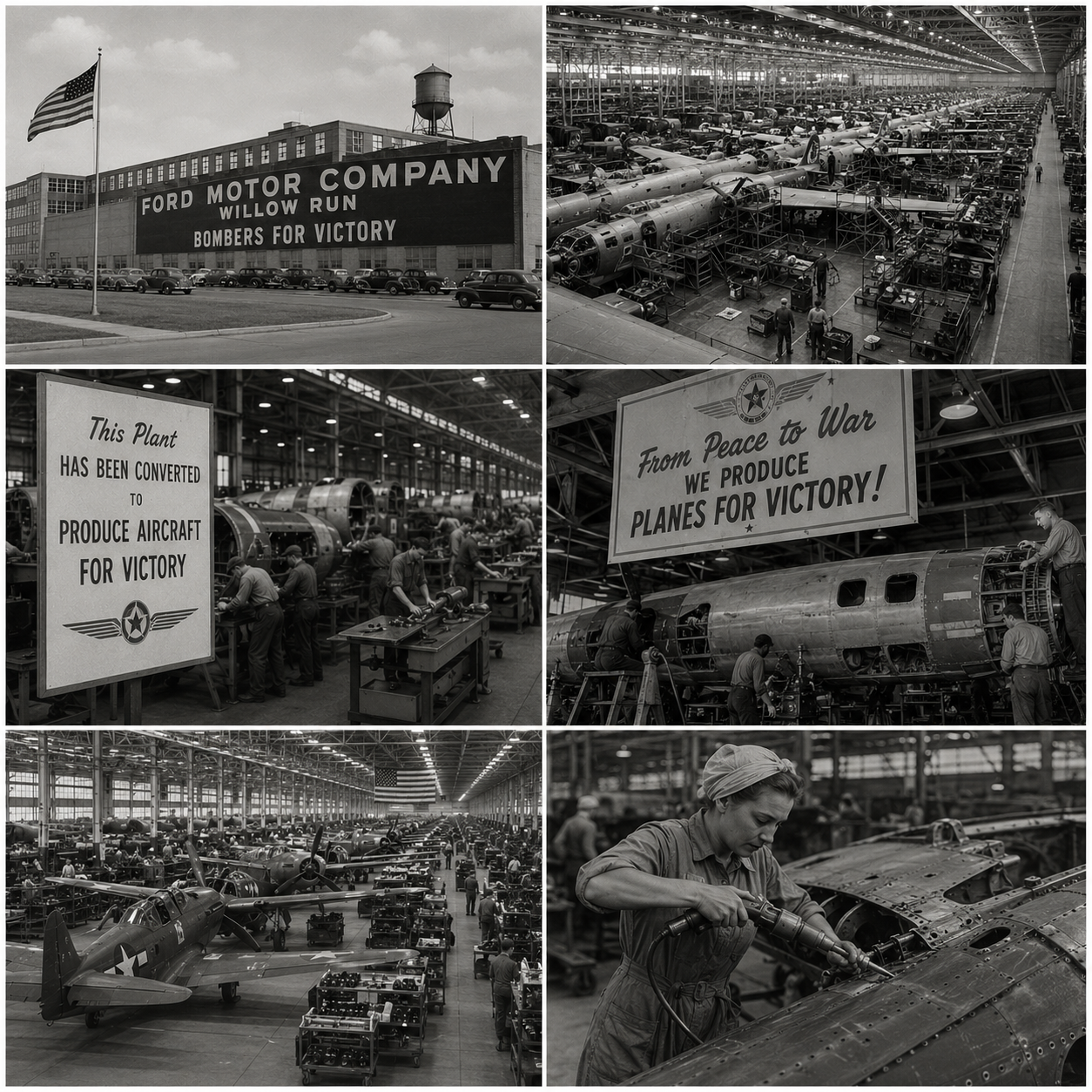
In the 1940s, the nation mobilized factories, training centers, and industrial facilities to meet a national need. Manufacturers, like Ford Motor Company right here in Michigan, that had never built aircraft suddenly became part of the aviation ecosystem. At Willow Run alone Ford produced one new aircraft every hour! Training programs expanded rapidly. Industry and education worked together toward a common mission.
The solution required creativity, partnership, and a willingness to rethink how training was delivered. That same spirit inspires the mission of Novelty Air.
We believe aviation maintenance education can no longer exist solely inside traditional classrooms and training facilities. The future of workforce development will require employers, educators, veterans, and industry leaders to work together to expand access to training opportunities where students can learn in authentic operational environments.
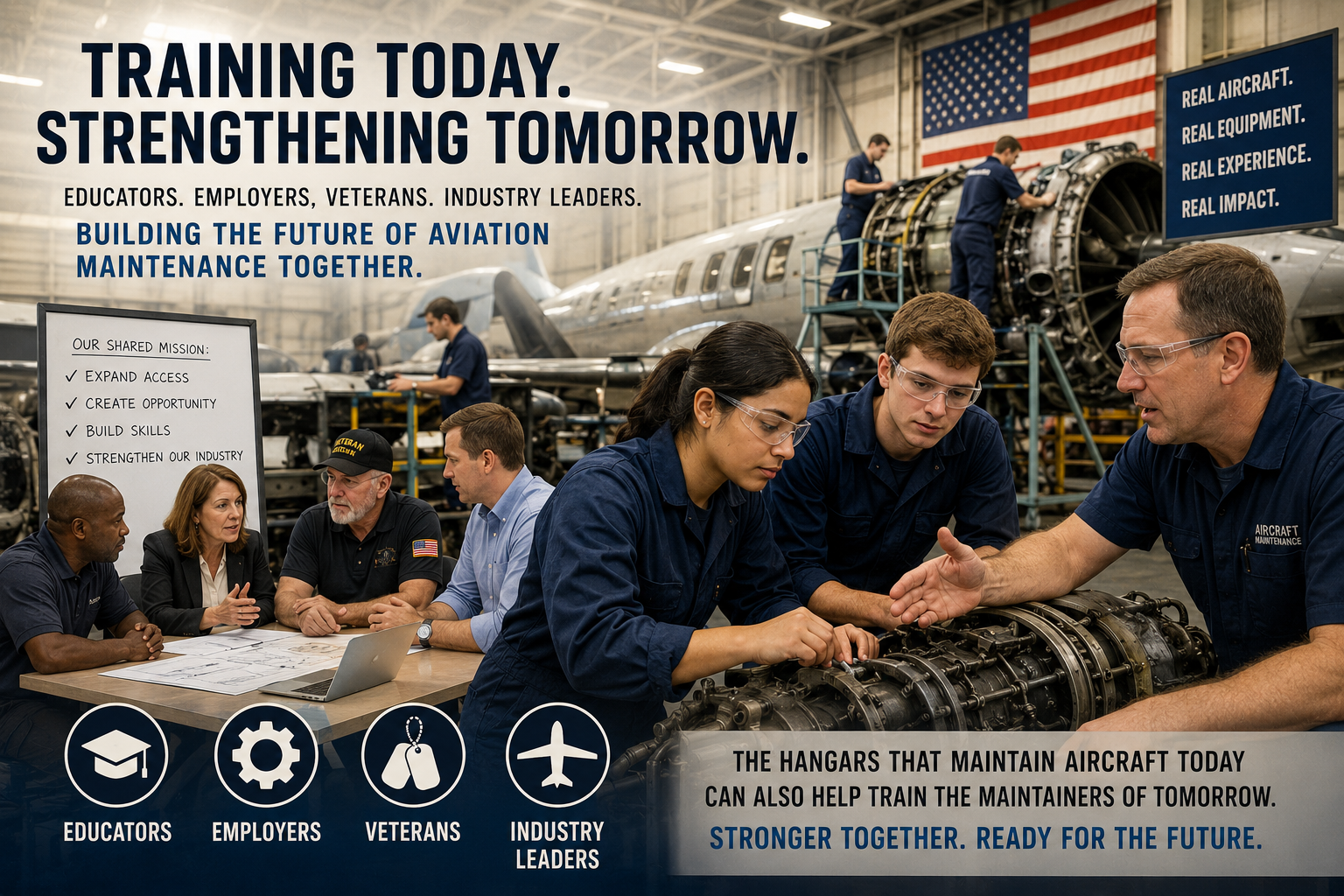
Just as America mobilized its industrial capacity during World War II, we believe today's aviation industry can mobilize its maintenance facilities, hangars, and technical expertise to help educate the next generation of technicians. The hangars that maintain aircraft today can also help train the maintainers of tomorrow.
That vision is at the heart of the Novelty AIR model: Aviation. Innovation. Readiness.
As we remember D-Day and honor those who served, we also recognize the legacy they left behind. The maintainers of World War II demonstrated that technical excellence, accountability, and craftsmanship can influence the outcome of history itself. Their names may not appear in every history book, but their work carried paratroopers into Normandy, protected bomber crews over Europe, and helped secure Allied victory.
Eighty-two years later, their example continues to inspire our profession.
Dedicated to the pilots, crews, mechanics, maintainers, and support personnel whose service and sacrifice helped secure freedom during World War II—and to the next generation of aviation professionals who carry that legacy forward.
#DDay #Normandy #NeverForget #WorldWarII #MilitaryHistory #Veterans #AviationHistory #AviationMaintenance #AircraftMechanics #WorkforceDevelopment #TechnicalEducation #FutureOfAviation #NoveltyAIR
For those who want more information, please reference the research below that we gathered for this article:

Author: Peter S. Lane
Subject Matter Expertise: FAA Part 147 Aviation Maintenance Education, Workforce Development, Industry Partnerships, Educational Technology
Affiliations: Founding Executive for multiple FAA Part-147 Aviation Maintenance Technician Schools (AMTS); member Aviation Technician Education Council (ATEC); attendee VERTICON, MRO AMERICAS, and ATEC Annual Conference.
««««««««««««««««««««««««««««««««««««««««««««««««««««««««««««««««««««««««
Novelty AIR’s Research of WWII Aviation Mechanics:
Why this story matters
Allied aviation maintenance was not a background function to victory in Europe, it was one of the systems that made victory possible. The National Museum of the U.S. Air Force notes that a single routine World War II bombing mission required at least 500 distinct skills, and that by 1945 nearly one-third of all enlisted personnel in the Army Air Forces had become mechanics. In other words, the men and women on the line, in the hangars, in the depots, and on the recovery teams were not peripheral to air power; they were a large share of the machinery that produced it. [1]
That argument becomes especially powerful in the run-up to Normandy. Before the invasion, Ninth Air Force service units in Britain modified and repaired roughly 2,400 aircraft between February and May 1944, while Eighth Air Force repair organizations had already built a battle-damage system that, in early 1944, returned more than 83 percent of damaged heavy bombers to service within five days and almost half within twenty-four hours. On 6 June itself, Allied aircraft flew about 13,000 sorties, and RAF reporting counted nearly 11,590 aircraft taking part in the operation. Those sortie totals were not simply a pilot story. They were the output of an industrial maintenance story run from English airfields and repair depots. [2]
Air superiority, airborne insertion, close support, interdiction, and the later drive into Germany all depended on a maintenance ecosystem that could absorb battle damage, move forward with the front, and sustain high serviceability under pressure. The official history of the Ninth Air Force shows that even after D-Day, when air units were constantly relocating and operating under rough field conditions, fighter serviceability on combat stations still averaged over 80 percent and rose above 90 percent by April 1945. This is the kind of evidence that showcases craftsmanship as combat power. [3]
The maintenance machine in Britain
The Allied buildup in Britain required an enormous maintenance labor force. The National Museum of the U.S. Air Force records that, by the end of the war, nearly one-third of all enlisted Army Air Forces personnel were mechanics, and official AAF history states that the ratio of total ground personnel to flying personnel was nearly seven to one. This was not merely manpower in the abstract. It was a mass of technicians, inspectors, armorers, electricians, radio men, sheet-metal workers, propeller specialists, welders, and engine mechanics organized to keep aircraft serviceable at tempo. [4]
The training pipeline expanded at wartime speed. AAF planners had already set goals of roughly 52,000 airplane mechanic graduates by early 1942, then moved to targets of 110,000 technicians per year, and by March 1943 technical schools were entering 62,000 students at once. Official AAF history adds that more than 700,000 graduates completed maintenance courses given by or for the AAF between July 1939 and August 1945, even allowing for some men taking more than one course. [5]
Just as important, the methods changed. Before the war, the basic airplane mechanics course lasted thirty-eight weeks. By July 1943, the standard course had been cut to 112 days, less than half the prewar length, and it included practical work on structures, systems, engines, propellers, engine changes, preflight inspections, daily inspections, and periodic inspections under simulated field conditions. General Henry Arnold criticized over-theoretical instruction in 1942, leading the Technical Training Command to put schools on a twenty-four-hour, seven-day schedule and to shift from lecture-heavy teaching toward demonstration-and-practice at the bench. Beginning in 1942, graduates also went to factory schools for type-specific instruction, and mobile training units were later designed, in the official phrasing, to “bring the school to the student.” [6]
The scale of this training was visible at the big schools. At Lincoln Army Air Base, Nebraska, nearly 30,000 fighter-mechanics had graduated by mid-1943, with a five-month program that ended in simulated war-zone conditions. At Sheppard Field, officials improvised with borrowed tools and barracks-as-classrooms in 1941, then expanded to continuous three-shift, twenty-four-hour training and produced more than 7,700 aviation mechanics during the war. These schools were not glamorous, but they were one of the places where D-Day was made. [7]
The work itself was carefully tiered. A background paper prepared for the Air Force Enlisted Heritage Research Institute, drawing on wartime regulations and official histories, summarized the four-echelon system this way: first echelon covered routine servicing, preflight and daily inspections, and minor repairs; second echelon added periodic inspections and some component changes, including engine changes when local capability existed; third echelon covered field repairs and replacements that required mobile machinery and specialized mechanics; fourth echelon was complete restoration and heavy overhaul. The same paper also lists the wartime specialist trades that made this possible, including engine mechanics, propeller specialists, aircraft welders, instrument specialists, aircraft metal workers, and aircraft electricians. [8]
Who the maintainers were
At squadron level, maintenance was personal as well as industrial. Official AAF history says primary responsibility belonged to teams of enlisted mechanics led by a noncommissioned officer called a crew chief, while a nonflying squadron engineering officer supervised the larger maintenance effort. The AFEHRI background paper adds useful scale: fighter squadrons typically had about 160 to 175 enlisted ground personnel, and bombardment squadrons about 180 to 250, depending on aircraft type. This combination of a named crew chief, a fixed aircraft, and a larger squadron engineering structure is one of the most important human details, because it explains why pilots trusted “their” mechanics so deeply. [9]
The exact average age of Allied maintenance crews in northwest Europe is difficult to pin down from the open-source administrative record, and that is worth saying plainly in the white paper. What the record does show is that this was a very young force. U.S. draft policy in World War II drew from men aged 18 through 45, while the wartime Civilian Pilot Training and War Training pipeline for mechanics accepted men 18 through 37. In the RAF’s women’s service, the RAF Museum states that the majority of WAAF members were between 18 and 40. Taken together with the compressed training pipeline and the testimonies of school and unit histories, the safest inference is that many of the line mechanics and technicians around D-Day were in their late teens or twenties, usually working under somewhat older NCO crew chiefs and engineering officers rather than under senior master craftsmen of middle age. [10]
This was also a more diverse story than popular memory usually allows. By 1945, a quarter of a million women had served in the WAAF in more than 110 trades, including work “from administrative duties to maintaining and repairing aircraft,” with some trades requiring attendance at specialized schools before posting. RAF Museum sources also note that between June 1944 and March 1945 more than 5,500 Black Caribbean volunteers arrived in Britain to serve as ground staff across a wide range of trades, and that figures such as Leading Aircraftwoman Sonia Thompson qualified as instrument repairers. Even clothing records tell the story: WAAF personnel were issued overall suits and working garments for heavy jobs such as aircraft servicing and doping, which makes clear that their labor was physical, technical, and dirty, not ceremonial. [11]
From battle damage to next sortie
The hardest evidence for the importance of maintenance comes from battle-damage data. In late 1943, General Ira Eaker warned that in the European theater “the maintenance establishment controls the scale of operation,” because on deep penetration missions into Germany it was normal for 25 to 50 percent of aircraft to suffer some form of battle damage. The official history says that during the second half of 1943 roughly 30 percent of all bomber sorties resulted in battle damage; of 5,330 damaged aircraft, 722 suffered major damage requiring extensive repairs. This is exactly the historical backbone for the image you want to evoke: bombers and fighters limping back across the Channel, shot through by flak or fighters, to crews who had to decide whether they could be turned quickly, sent to a subdepot, or pushed farther back into the repair chain. [12]
The repair system became remarkably effective by the spring before D-Day. The official AAF history reports that damaged bombers were divided into four categories after inspection and assigned to the proper maintenance echelon; subdepots, mobile repair units, and working parties handled the faster-turn work, while larger depots supported the heavy end of the problem. In a special study covering 21 January through 30 April 1944, 8,859 out of 33,065 heavy bomber sorties ended with battle damage, yet subdepots and their supporting mobile units repaired 83.44 percent of the damaged bombers within five days, and almost 50 percent within twenty-four hours. The same history notes that sheet-metal demand became so heavy that each strategic depot needed roughly 300 to 400 sheet-metal workers. [12]
Speed did not mean chaos. In November 1943, Eighth Air Force Memorandum 65-6 established a hard boundary: combat units were to do only maintenance and repair that could be completed within thirty-six hours. Aircraft requiring more work were passed to subdepots or service squadrons, and when damage loads were unusually heavy, working parties from more advanced depots were sent forward to help. For today’s modern maintenance audience this matters more because it shows that wartime success was not built on reckless improvisation alone. It was built on triage, standards, trade specialization, mobility, and disciplined handoffs between maintenance levels. [13]
A vivid British example came just after D-Day. Marshall of Cambridge received three shot-up RAF Dakotas on 8 June 1944, damaged during Operation Overlord support flights. One aircraft had a badly damaged port mainplane, so the repair team cannibalized the undamaged port mainplane from another Dakota to get the first aircraft back into service quickly; other damage included fuselage hits, tank-bay damage, tug-release cable damage, and mainplane damage. One Dakota was returned to service in under forty-eight hours, and the other two in under five days. Marshall’s own wartime recollections also describe “shot-up” Typhoons arriving for quick-turn repairs and teams working 80 to 90 hours a week after D-Day. This is precisely the kind of concrete anecdote that makes the broader statistics human. [14]
Normandy and the road into Germany
On D-Day, the scale of the Allied air effort was enormous. Official air-history summaries record that 171 British and AAF fighter squadrons performed tasks ranging from shipping cover and beach cover to bomber escort, inland strikes, and direct air support, while the broader Allied air effort flew around 13,000 sorties on 6 June. RAF Benevolent Fund material places the number of aircraft involved at nearly 11,590. By contrast, the U.S. Military Academy’s history of the campaign notes that only about fifty German sorties were attempted over the assault beaches and approaches that day. The air armada that appears in every popular retelling therefore rested on an air maintenance system that had already done its work before the first troop reached sand. [15]
The maintainers were not all left behind in England. RAF figures for 6 June state that more than 1,800 RAF personnel and 456 vehicles landed in Normandy on D-Day to support airfield construction, aircraft servicing, and forward control, and that these totals had risen to over 3,500 personnel and 815 vehicles by 9 June. The National Museum of the U.S. Air Force likewise emphasizes how quickly aviation engineers established airstrips in Normandy farmland so fighters could move closer to the front. This is a powerful corrective to the idea that maintenance was a rear-area job. On and after D-Day, air support crews were physically part of the invasion infrastructure. [16]
The U.S. Ninth Air Force had prepared for exactly that mobility. Its service command modified roughly 2,400 aircraft between February and May 1944; pre-stocked combat bases in Britain; planned 90,000 gallons of aviation gasoline for each advanced landing ground to reduce exposure to road congestion; and maintained a reserve replacement pool of roughly 3,000 men in England for expected noncombat losses on the continent. Official history also shows that by D-Day the Ninth was self-sufficient in the first three echelons of maintenance, relying only partly on rear depots for fourth-echelon work. Its service teams, each containing about 500 men and including mobile reclamation and repair units, could move with combat groups and provide on-site repairs, routine maintenance, salvage, and even help with glider and aircraft assembly. [17]
Once the war moved off the beaches, the problem became sustaining air power across a moving front. By the end of 1944, many Ninth Air Force airdrome squadrons on the continent had already moved seven or eight times, and by late September the supply line stretched some 600 miles from the Normandy beaches to the Siegfried Line. In spite of that, official history says fighter serviceability on combat stations averaged above 80 percent after D-Day and climbed מעל 90 percent by April 1945. That is one of the clearest possible proofs that the maintainers’ contribution did not end with Normandy. It followed the Allied armies across France and into Germany. [3]
What they pioneered
The best evidence of pioneering maintenance crews is not vague admiration. It is the way the war forced the Allies, especially the AAF, to build methods that look strikingly modern: shorter and more practical basic courses; aircraft-type specialization; factory follow-on schools; continuous refresher training; clear separation between line maintenance and heavier depot work; and mobile training units that carried tools, charts, mock-ups, and even manufacturer representatives to the units that needed them. Official AAF history shows all of these developments clearly, and it also shows how schooling shifted from lectures toward hands-on bench instruction under wartime pressure. [18]
The wartime record also suggests that one of the conflict’s biggest maintenance innovations was cultural rather than purely technical: ownership. The crew-chief system put named mechanics in close, repeated contact with individual aircraft, while larger engineering structures ensured that repairs stayed tied to standards and inspection cycles. In practical terms, that meant pilots did not simply trust “the maintenance department.” They trusted the crew chief, the armorer, the rigger, the instrument man, and the engineering officer whose work touched their aircraft again and again. Official AAF history describes that system plainly, and the RAF side tells a similar story through the visibility of specialist trades and servicing units. [19]
One of the most useful analytical points for a modern audience is this: the wartime maintainers did not just repair aircraft, they taught later generations how to think about availability. Their methods joined airworthiness to tempo; they accepted that not everything should be done on the line; they used triage and escalation; and they treated training as continuous, not one-and-done. That connection to today’s aviation maintenance profession is partly an inference, but it is a strong one because the wartime system already contains the essential features of modern practice: type familiarity, inspection discipline, trade specialization, field/depot separation, and recurrent instruction close to the operator. [20]
REFERENCES:
[2][17]https://www.ibiblio.org/hyperwar/AAF/III/AAF-III-5.html
[3]https://www.ibiblio.org/hyperwar/AAF/III/AAF-III-16.html
[5]https://www.ibiblio.org/hyperwar/AAF/VI/AAF-VI-14.html
[6][9][18][19]https://www.ibiblio.org/hyperwar/AAF/VI/AAF-VI-19.html
[8]https://www.airuniversity.af.edu/Portals/10/AFEHRI/documents/EnlistedHistory/metz.pdf
[12][13][20]https://www.ibiblio.org/hyperwar/AAF/II/AAF-II-19.html
[14]https://marshallgroup.com/en/news-stories/how-marshall-kept-dakotas-flying-above-normandy
[15]https://www.ibiblio.org/hyperwar/AAF/AAF-H-DDay/
[16]https://www.rafbf.org/d-day/raf-involvement-in-d-day
[21]https://www.ibiblio.org/hyperwar/USA/USMA/WEurope1/WEurope1-3.html
